3.2 Interface connection

About

The MDSC-8231 can have multiple video inputs connected. Switching between the different inputs can be done easily with the Source shortkey ().

Futhermore, if more than one video source is connected, the Picture in Picture and Picture and Picture (PiP/PaP) functionalities become available, allowing you to view 2 different video inputs at once. Refer to “Picture and Picture input” and “Picture in Picture input” for more information.

Beside the video input connections, the MDSC-8231 also has video output capabilities allowing you to loop-through or duplicate all video inputs connected with the MDSC-8231 to another display, projector, video recorder, ...

This chapter describes how to connect the different video interface types to the MDSC-8231.
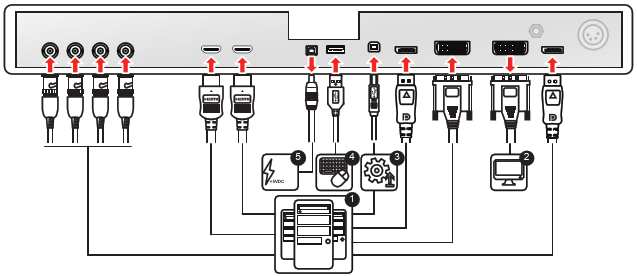
To connect the interfaces
  1. Connect one or more video source(s) to the corresponding video inputs of the display. For a list of supported video inputs, see “Technical specifications”. See “SDI config” about the possible SDI configuration modes.
  2. Screen image clone: The entire active image on the screen (including OSD) can be duplicated to a FHD (1080p/1080i) signal on the DVI output connector, to which an additional DVI video sink can be connected.
  3. Connect the USB2.0 type B interface with a workstation to use the remote control protocol, to update the display firmware, or to be able to connect any USB peripheral with the USB interfaces of the display.
  4. Use any USB peripheral (keyboard, mouse, webcam, ...) by connecting it to the available USB interfaces.
  5. Connector +5 VDC - 2A power out for accessory (Mating connector HIROSE RP34L-5PA- 2SC(1857)(71)).
Image 3–2
Note: DisplayPort VESA DP 1.2 certified cables for 5.4 Gbps HBR2 with a length of up to 2 m are recommended.
Note: Premium certified HDMI 2.0 cables with a length of up to 3 m are recommended.
Note: 3G-SDI Belden 1694A cables with a length of up to 50 m and 12G-SDI Belden 4855R cables with a length of up to 30 m are recommended.
Note: The DVI output must be enabled in the OSD menu (please refer to “DVI output”).
Note: A subset of the commands of the remote control protocol is also available on a new DDC protocol on DVI and DisplayPort1 auxiliary channel.