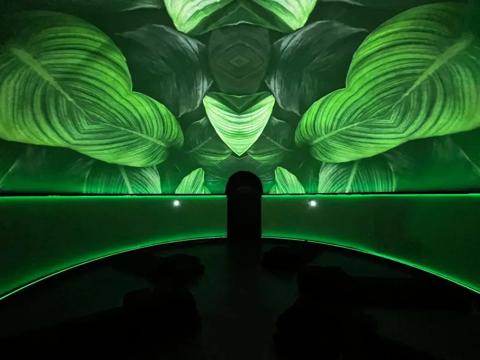
In pursuing research into modern life, Ritsumeikan University in Japan established the Crossverse Innovation Commons (CVIC). This facility represents a shift in how academic institutions are approaching the intersection of human behaviour and technology.
The university’s vision was to establish a world-class research environment where scientists, engineers, and creative professionals could study how humans interact with digital and physical environments in complex, layered realities. This research domain has been termed “Human Augmented Sphere” and explores questions that are increasingly vital to modern society.
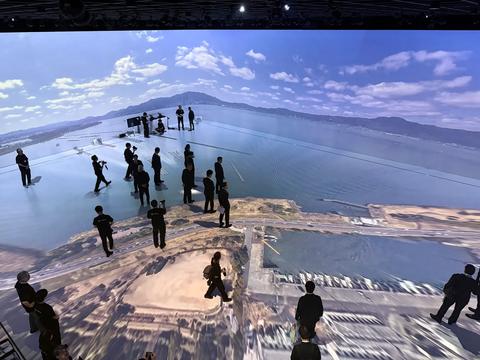
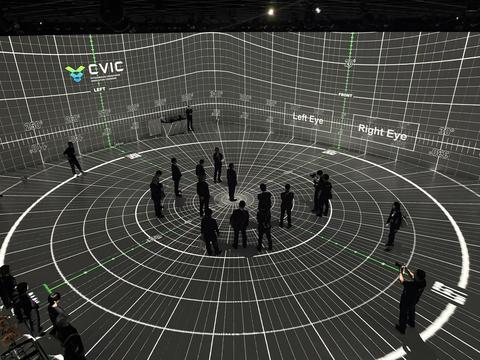
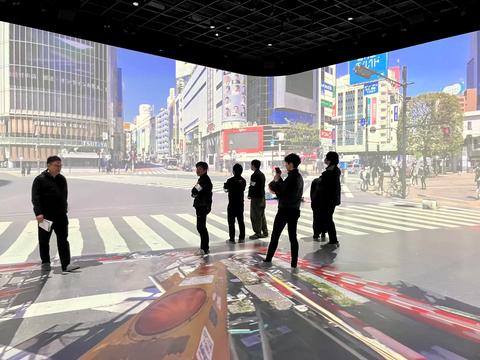
Central to the function of the CVIC is the X-Verse Arena, which is a gymnasium-scale immersive environment spanning approximately 420 sq m. Its walls and floor form a continuous, curved projection surface.
The X-Verse Arena within CVIC evokes an effect straight out of a science fiction movie, where cutting-edge video, sound, motion capture, mixed reality, and scent have been seamlessly integrated.
Within this sphere, researchers needed to layer multiple technologies in perfect harmony. From motion capture systems to track human movement with exceptional precision to 360-degree visual projection to envelop participants in seamless imagery, technology brings the university’s vision to life.
At X-Verse Arena, mixed and extended reality (MR/XR) systems blend real and virtual elements together with spatial audio that places sound with three-dimensional accuracy.
No one had previously orchestrated an immersive installation of this calibre and the main challenge was conceptual. How do you create a space where cutting-edge research appears seamless and where researchers and participants can focus entirely on the phenomena they are studying?
Extraordinary demands
Geometric precision in dome and curved environments is one of the most demanding projection challenges in visualisation. When you attempt to merge multiple projectors across curved surfaces, particularly when those surfaces extend from walls to floor in an unbroken arc, the technical hurdles multiply exponentially.
At the X-Verse Arena, system integrator Visual Graphics, Inc. faced several formidable obstacles. The first was seamlessly blending projectors without visible seams, colour shifts, or inconsistencies in brightness. The second happened to be rendering immersive content at the resolution and refresh rates demanded by research applications, where any visual glitch could compromise experimental validity. Last but not least, shadow elimination was crucial so that researchers and participants moving within the arena would not cast shadows that disrupted the visual environment.
The facility also had to handle real-time interaction. As participants moved within the space, their motion data captured by 100 Vicon cameras mounted overhead needed to be translated instantaneously into visual feedback rendered across the projectors. Any latency and any misalignment would rupture the sense of immersion upon which the research fundamentally relies.
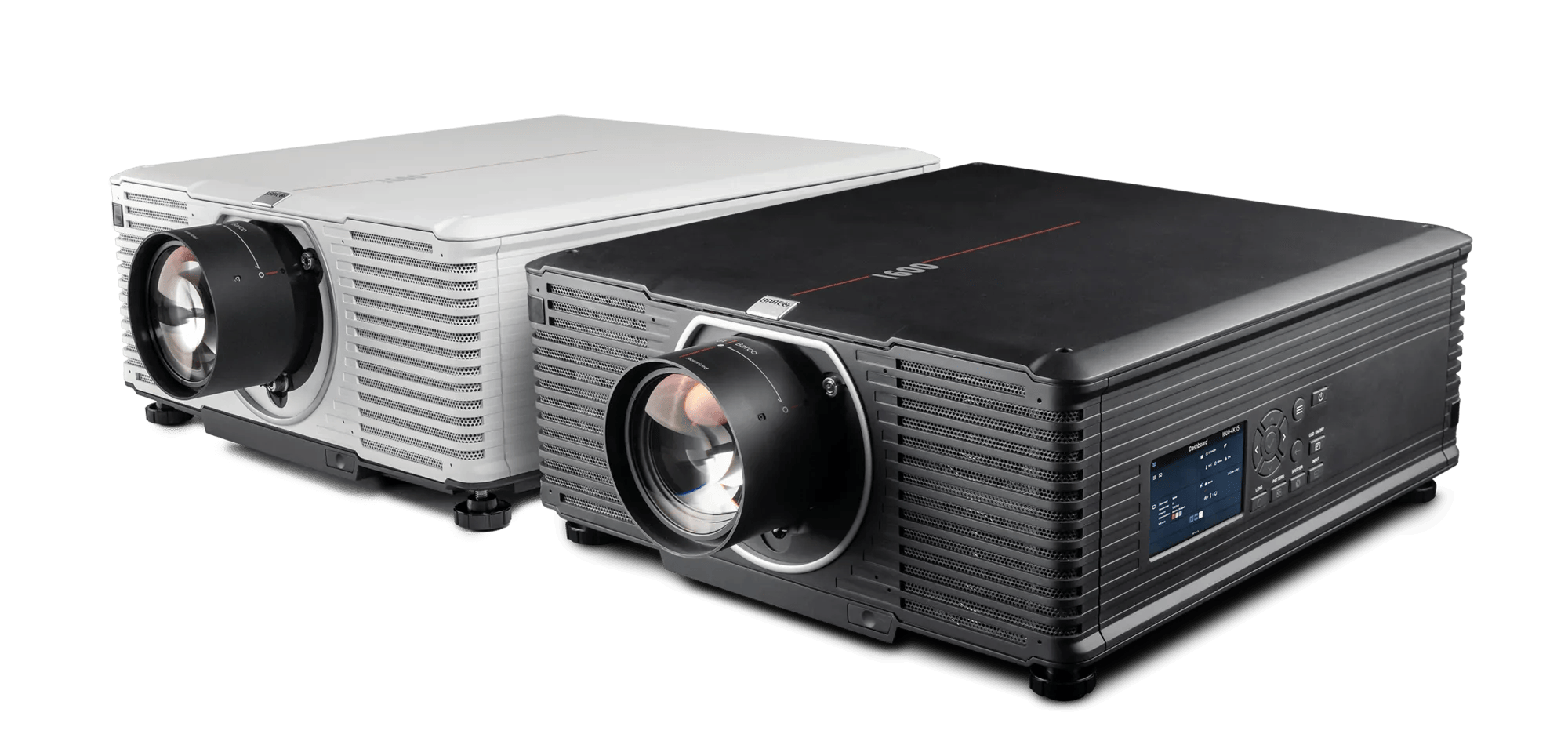
Barco projectors were selected to address the challenges based on the fact that they possessed the technical capability to deliver the level of synchronisation, image quality, and geometric precision required. The university specified 14 Barco I600-4K15 4K laser projectors, each equipped with advanced blending and warping capabilities essential for curved-surface applications.
Barco’s 4K laser systems brought several decisive advantages to the project. Laser light sources maintain stable output across tens of thousands of operating hours, critical when multiple projectors must maintain perfect brightness consistency across extended research sessions. Unlike lamp-based alternatives, laser projectors exhibit minimal colour drift, an essential attribute in environments where colour-accurate research is conducted.
Equally significant was Barco’s advanced image processing architecture. The projectors are equipped with sophisticated geometric correction tools that enabled VGI to mathematically compensate for the curved geometry of the arena, warping each projector’s output so that when combined, the 14 images fused into a single, coherent visual field. The projectors’ 4K resolution, 3840 by 2,400 pixels per unit, ensured that even when spread across the vast curved surface, the visual acuity remained sufficient for research-grade applications.
Moreover, Barco’s projectors integrate seamlessly with clustering technologies and real-time rendering pipelines. The X-Verse Arena runs a sophisticated PC cluster, coordinating content generation across multiple machines. Barco’s architecture supports frame-accurate synchronisation across all 14 units, ensuring that as new frames are rendered, every projector advances in perfect unison. Even microsecond-level timing errors would manifest as visible flicker, a phenomenon entirely absent from the completed installation, testament to the precision engineering involved.
The art of orchestration
Translating Barco’s technical capabilities into operational reality demanded skill from VGI. The team ensured perfect geometric calibration, physically measuring the arena’s curve, modelling it in software, and then mathematically warping each Barco projector’s output to match. Edge blending, the zone where two projectors’ images overlap, had to be calibrated not just for brightness, but for perceived image quality, ensuring participants never detected the seam.
The installation also confronted a unique aesthetic challenge. In environments designed for maximal immersion, every detail matters. VGI made the deliberate choice to paint all equipment inside the arena white. The technical apparatus became nearly invisible, allowing viewers’ attention to settle entirely upon the projected imagery.
A new frontier
When the X-Verse Arena officially opened in May 2026, visitors encountered a space where one’s sense of presence and spatial awareness undergoes a shift. The curved projection surface, combined with spatial audio from 16 speakers and 4 subwoofers, creates a cocoon of immersion. Participants are no longer observing a presentation; they are inside it.
The inaugural demonstrations showcased the arena’s capabilities compellingly. An 8K 360-degree opening sequence visualised the concept of Human Augmented Sphere, enveloping visitors in a gradient transitioning from skin-level physical reality into digital space.
Interactive demos allowed participants to move within the space whilst the motion capture system translated their motion into real-time visual feedback. A virtual orchestral performance demonstrated MR capabilities, with participants viewing through MR headsets perceiving an orchestra positioned correctly within the physical space, with audio realism tuned so that walking closer to individual musicians caused their sound to swell naturally.
For Ritsumeikan University, the X-Verse Arena represents a critical infrastructure asset for research into human-computer interaction, cognitive psychology, healthcare applications, sports science, and creative expression. The facility positions the university at the forefront of global research into embodied cognition and immersive media.
The success of the X-Verse Arena illustrates the fact that large-scale immersive environments work when the technology becomes invisible. Users, whether researchers conducting experiments or visitors experiencing a demonstration, should never consciously think about the projectors, the blending algorithms, or the geometric corrections. They should simply inhabit the space.
That invisibility is only achieved through meticulous selection of component systems, precision engineering during installation, and an uncompromising commitment to image quality. Barco’s 4K laser projectors, combined with VGI’s technical expertise, created the foundational layer upon which Ritsumeikan’s research ambitions could flourish.
Seiichi Nakamura, Territory Sales Manager Barco Japan said, “We are proud that Barco projection technology has played a vital role in bringing Ritsumeikan University’s ambitious X-Verse Arena to life. This project reflects the power of precision imaging to enable new forms of research, creativity, and human interaction. Together with VGI and Ritsumeikan University, we are helping shape the next frontier of immersive innovation.”
As immersive technologies increasingly permeate education, healthcare, entertainment, and research, the X-Verse Arena stands as a model and an aspiration. It demonstrates what becomes possible when leading-edge projection technology meets ambitious research vision.