Поиск Barco

Уведомления myBarco

Непрочитанные

Прочитанные

У вас нет никаких уведомлений.
Продукты
Продукты

University of Applied Sciences Kempten relies on Barco 240 Hz projector for their driving simulator

Kempten, DE · 2022

The Institute for Driver Assistance and Connected Mobility (IFM) is an institution of the University of Applied Sciences Kempten (Germany). It is a method manufacturer, whose objective is to create the methods and tools for car manufacturers and their supplier to limit the number of prototypes. They focus on three main domains: ‘vehicle dynamics and controls with steering, tire and suspension application’, ‘controllability in failure cases’, and ‘ADAS/AD (Advanced Driving Assistance System / Automatic Driving)’.

Key benefits:

  • 240 Hz for true-to-life response and better ergonomics
  • Simple handling of the projector
  • Very realistic image reproduction

Designing new car models is very expensive and time-consuming. Especially the construction of physical prototypes slows down the process. Today’s advanced simulators enable to conduct many of the initial tests in the driving simulator.

In this way, the maturity of the new car is a lot higher before the first prototype is created. If 70% or 80% of the work is done on a virtual prototype, this will save a huge amount of time and money on the car development costs. The simulators are therefore crucial to experience the driving, and all car manufacturers have several of them in their research facilities.

When moving to a new building, IFM decided to upgrade their driving simulator because the existing screen was not big enough. Test drivers could always see the wall, which took away the realism. They could not simply port the visualization system to a bigger screen (because additional projectors were needed), so they took the opportunity to create a completely new system.

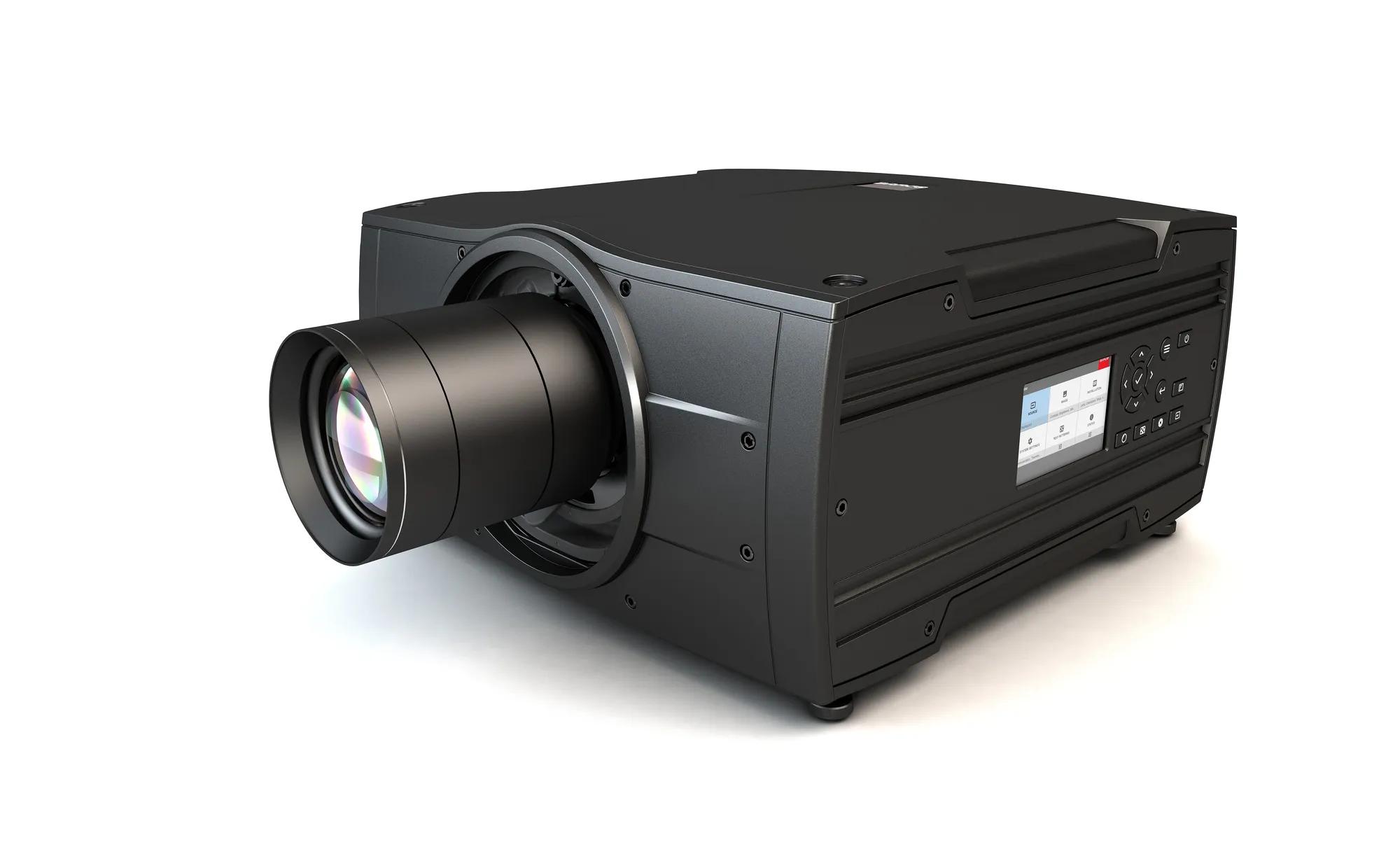
The choice was to go for Barco’s FL40-4K. One of the big differences between Barco and the competition, was the much simpler handling of the projector.

High-speed simulators require high-speed projectors

“Visualization systems are obviously very important for simulators”, says Professor Bernhard Schick, the founder and director of IFM. “Not only the color reproduction, resolution and brightness performance of the projector. For us, the frame rate is absolutely crucial. In high dynamic driving it is obvious you need this high frame rate, for example when the car starts to yaw. But it is also a great addition in other use cases.

The upgrade from 60 Hz to 120 Hz was already a big step forward, but the move from 120 Hz to 240 Hz is just as big. Test drivers that spend 8 hours in the simulator, for example, say it significantly reduces motion sickness and stress. Additionally, the more realistic the environment looks, the more trust people have. So, there are psychological issues as well.”

 
One of the big differences between Barco and the competition, was the much simpler handling of the projector.

Professor Bernhard Schick

The upgrade from 60 Hz to 120 Hz was already a big step forward, but the move from 120 Hz to 240 Hz is just as big.

Professor Bernhard Schick

Related customer stories

The upgrade behind better pilot readiness with Havelsan Full Mision Simulators powered by Barco FS40
2026 · Türkiye

The upgrade behind better pilot readiness

In advanced pilot training, realism is essential. Visual systems must create immersive environments that help trainees build confidence, sharpen situational awareness, and develop critical skills in a safe and controlled setting. When HAVELSAN set out to modernize two Full Mission Simulators, the organization selected Barco to deliver the largest and most complex visual display upgrade project in its simulator portfolio, enhancing image quality while improving long-term reliability and maintainability.
Driving enhanced simulator experiences at General Motors with Barco F80
2025 · The United States

Driving enhanced simulator experiences at General Motors

General Motors (GM) is one of the world's largest automakers and is known for its brands, including Chevrolet, Buick, GMC, and Cadillac. The company also has a rich history of using driving simulators to study human factors in driving. Recently, GM upgraded the performance of a key driving simulator’s motion system and steering feedback system with the latest electronics and refurbished its visual system with Barco F80 projectors.