Précédent
How Julie accelerates innovation for Barco through her Prince Albert Fund adventure in Silicon Valley
3 min de lecture
When Julie Coorevits packed her bags for San Francisco, she wasn’t just starting a new role, she was stepping into a unique Prince Albert Fund assignment. The program supports the leadership development of young Belgian professionals through entrepreneurial roles abroad, and for Julie, that meant representing Barco in the heart of Silicon Valley.
Finding Barco through an unexpected door
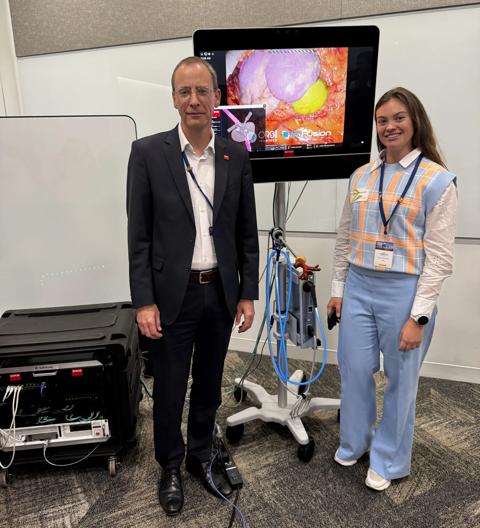
Julie together with Johan Fornier, Chief Strategy Advisor Healthcare, showcasing our AI-powered Brilliant Assistant during the Belgian Economic Mission to the West Coast USA
With a background in economics and hands‑on experience in computer vision and cybersecurity at startups, Julie looked for a project that matched her skills and experience. Through the Prince Albert Fund network, she connected with Barco’s Nexxis team and discovered something unexpected. “I didn’t realize Barco was so deeply involved in software and AI. With my experience in computer vision, it turned out to be a perfect match,” she says.
Her assignment focused on business development for Brilliant Assistant, Barco's brand-new AI-powered surgical display solution, combining computer vision models with a large language model that acts as a voice-assistant for surgeons and clinicians.
Starting in Kortrijk, growing in San Francisco
Before crossing the Atlantic, Julie spent several weeks with the team in Belgium.
“Meeting the team in person made a huge difference,” she says. “I quickly learned who to contact for support, legal, or R&D, and that made my move to the US much easier.”
Once she arrived in California, the culture shift was immediate: morning runs at 6 AM surrounded by dozens of fellow joggers, offices with massive parking lots rather than sidewalks, and a welcoming local team that immediately introduced her to the American way of working.
Innovation at full speed
Working from Silicon Valley, close to major AI players, Julie experienced innovation at full speed. New AI-models launched every week, partnerships formed quickly, and startups emerged just as fast.
“Things move incredibly fast here. AI-models often first launch in the US and are only made available in Europe a couple of weeks later.”
For Barco’s next‑generation surgical solutions, this proximity mattered. As part of her business development role, Julie helped set up a market strategy, built an overview of interesting third-party AI application companies, and connected with promising startups.
Showcasing innovation at NVIDIA GTC
A highlight for Julie was coordinating Barco’s presence at NVIDIA’s GPU Technology Conference (GTC). It’s one of the most influential tech events in the world, and Barco was selected among only twelve global healthcare innovators to exhibit at the Healthcare Pavillion.
“We showed our smart surgical display with real‑time AI models for the first time. Some things only came together days before the event, but the energy was incredible,” Julie recalls.
The booth attracted software vendors from around the world, and some of today’s ongoing partnerships started there.
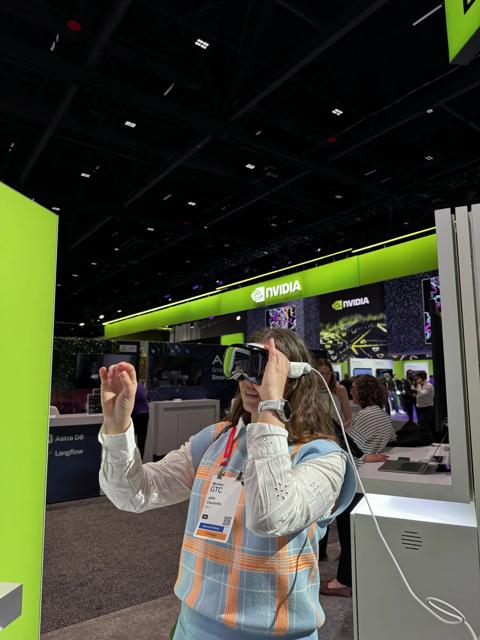
Julie at NVIDIA GTC
Lessons learned in a fast‑moving industry
Working across 2 different time zones with a 9-hour difference brought challenges. Early morning meetings, late‑evening follow‑ups, and the need to coordinate between teams in Belgium and the US made communication essential. Her tip? “Share meeting notes and recordings. Really – from day one. When you can’t attend every call, documentation becomes gold.”
She also experienced firsthand how important it is for technical teams to understand the real environment in which surgeons work. Observing surgeries before starting the assignment gave her valuable insights before her assignments. “If you want to understand operating room technology, go see a surgery. Talk to surgeons. Watch how they use the tools. That’s where you learn the most.”
Looking ahead: the future of AI in healthcare
Julie sees computer vision and AI becoming essential in operating rooms. “Surgeons see the potential, but the ecosystem still needs to evolve. It won’t happen overnight, but it’s clearly coming.”
Related articles


Précédent
de
...
Suivant