Zurück

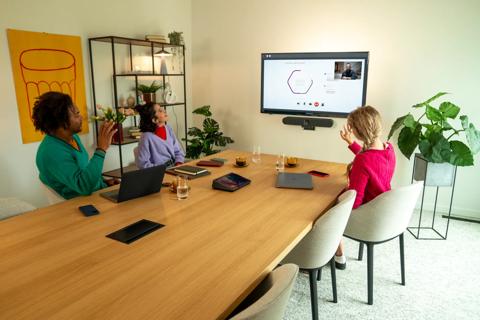
Here’s a question IT leaders are asking: Why do meeting rooms still feel so complicated? After years of hybrid work, meeting rooms should be the easiest part of collaboration, not the hardest. Yet enterprises continue wrestling with deployment complexity, underutilized spaces, and rooms that only work if you know the secret handshake.
The Omdia Universe: Smart Collaboration Devices, 2025 report reveals something striking: the market isn’t just growing – it's fundamentally reorganizing around a single principle: Flexibility beats complexity. Every time.
The meeting room challenge
Most organizations face the same collaboration gaps. According to Omdia, less than 25% of meeting rooms globally are equipped with video conferencing, not because organizations don’t want it, but because traditional approaches create barriers:
High per-room costs that hinder scalability
Complex installations requiring specialized IT expertise
Rigid configurations that don’t adapt to different room types
Management overhead that grows with each deployment
Obsolescence risk before ROI is achieved
The result? Small huddle rooms stay dark. Mid-sized spaces remain underutilized. And IT teams struggle to deliver video capabilities across the entire real estate portfolio without breaking the budget.

What’s changing: the shift toward modular, adaptable solutions
Omdia’s research identifies a market in rapid transition. Three trends are converging:
- The rise of Android-based solutions: Omdia forecasts 23% CAGR growth for videobars through 2029, driven by ease of deployment, affordability, and flexibility. Microsoft’s Device Ecosystem Platform (MDEP) is accelerating this shift by bringing enterprise-grade security and management to Android devices.
- The demand for modular approaches: Organizations want solutions they can customize to specific spaces – from compact wireless conferencing in huddle rooms to full room systems in boardrooms – without managing disparate technologies.
- The simplicity imperative: With roughly 50 vendors offering similar hardware, differentiation comes from ease of deployment, management efficiency, and ecosystem integration. The winners make technology invisible, letting people focus on collaboration instead of troubleshooting.
This creates both pressure and opportunity: pressure to upgrade legacy equipment and equip underutilized spaces, and opportunity to build a sustainable collaboration strategy that scales across diverse room types.
The ClickShare approach: from BYOD pioneer to complete portfolio
When Omdia evaluated the smart collaboration devices market, ClickShare earned recognition as a challenger with clear strengths in innovation (80%), small and mid-sized spaces (88%), and strategic execution (76%).
What stood out? Our modular approach addresses different collaboration needs across your meeting real estate:
For spaces where simplicity wins: ClickShare Conference wireless conferencing solutions let users walk in with their laptop and connect instantly to room audio and video equipment. Perfect for spaces where fast, cost-effective deployment and flexibility matter most. This platform-agnostic approach supports Microsoft Teams, Zoom, Google Meet, Webex, and more – giving employees choice without creating IT headaches.
For dedicated collaboration environments: ClickShare Hub, announced in June 2025, brings our wireless conferencing expertise into a modular room system built on Microsoft’s MDEP. One of the first MDEP-based modular room systems in the market, ClickShare Hub delivers enterprise-grade security, streamlined device management, and easy deployment – from small meeting rooms to large boardrooms. It’s designed for spaces where organizations want a dedicated, always-ready collaboration environment.
This portfolio breadth matters because meeting rooms aren’t always uniform. Some spaces benefit from BYOD flexibility. Others need dedicated systems. ClickShare delivers both – with consistent management through XMS Cloud and seamless integration with meeting room peripherals.
This modular approach recognizes what Omdia's research confirms: enterprises need choice, not constraints.
The path forward
Omdia’s report points toward continued innovation in AI-driven features, intelligent analytics, and immersive experiences. But the most valuable innovations won’t be the flashiest – they’ll be the ones that reduce friction.
ClickShare’s commitment to MDEP ensures that as collaboration technology evolves, your investment remains current. Quarterly firmware updates deliver new capabilities. Alliance Program partnerships expand peripheral options. And modular design means you can adapt to changing needs without starting from scratch.
The video conferencing market grew 10% year-over-year in 2024, but Omdia notes the most significant growth is in solutions prioritizing ease of deployment and management. That’s not coincidence – it’s what happens when vendors align with what enterprises actually need.
Ready to Simplify Your Hybrid Meetings?
Discover how ClickShare’s modular video conferencing systems can transform your meeting spaces - from huddle rooms to boardrooms.

Other articles by this author

Zurück
von
...
Weiter