Zurück
Securing the control room from source to pixel
Lesezeit 4 min
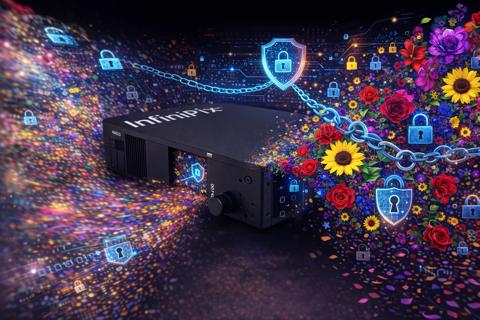
In a control room, every bit of information counts. Whether you are managing a power grid, coordinating emergency services, or overseeing a transportation network, the information on your screens drives the decisions that matter. But here is a question worth asking: how secure is that information, all the way from its source to the moment it lights up on your video wall or desktop monitor?
Most people think about cybersecurity in terms of networks, firewalls, and user access. Those things matter enormously. What is less often discussed is what happens further down the chain – through the processors, the cables, and all the way to the physical display. That final stretch is where Barco has made a bold move, with what we call “Security to the pixel”: a continuous chain of trust that protects your content from source to every individual LED pixel.
Why "good enough" security just won’t do
Control rooms are very rarely completely isolated islands. They typically connect to networks, pull in data from multiple sources, and increasingly operate as part of broader IT ecosystems. Every connection is a potential entry point for a bad actor. And in critical infrastructure environments, the consequences of a breach can affect public safety, national security, and essential services that millions of people depend on.
The challenge with many traditional video wall setups is that they are built from components sourced from different vendors. Each component may be secure on its own, but the gaps between them – the handoffs, the interfaces, the points where one vendor's responsibility ends, and another's begins – are exactly where vulnerabilities tend to hide.

One chain, no gaps
Barco's approach is built around a simple but powerful idea: if you want true security, you need to own and secure the entire signal path. Not just the network edge. Not just the content management layer. Every step, from the moment content enters the system to the moment it appears on screen.
Barco CTRL, our KVM over IT solution for control rooms, acts as the secure backbone of this chain and enables a unified security model across the entire system. Content and commands are encrypted in transit, authenticated end to end, and protected against unauthorized access or manipulation.
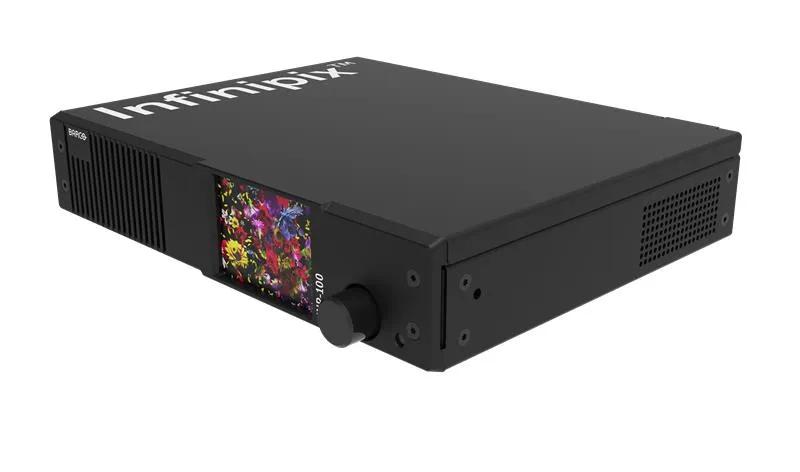
From there, the Barco Infinipix image processor – designed and manufactured in Europe – takes over. It uses encrypted communication between the wall manager, the processors, and the LED components. Pre-provisioned digital certificates ensure that only authorized devices can communicate with each other. A rogue device can never join the communication.
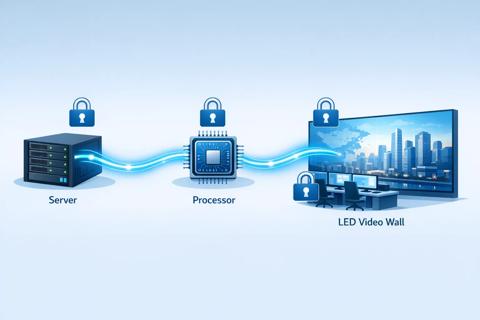
And then comes the part that sets Barco apart: security all the way to the LED panels’ receiver cards. The signal path between the processor and the display is secured, meaning that video content cannot be intercepted or altered in that final stretch, and control commands cannot be spoofed or injected. What appears on your display is exactly what was sent – nothing more, nothing less.
Security by design, not by accident
What makes this approach meaningful is not just what it does, but how it was built. Barco CTRL was designed from the ground up following Security by Design principles – meaning security was not added as a layer on top of an existing product but was baked into every architectural decision from day one. This includes a Zero Trust model, where nothing is assumed to be safe by default: every user, every device, and every connection have to prove it belongs there.
This philosophy extends to how the system handles updates. System updates for Barco CTRL can be rolled out across the entire installation from a central location in a single action – typically in no more time than a coffee break. In environments where delayed introduction of security updates is one of the most common causes of breaches, that kind of effortless update process is not a small thing.
Barco also backs this up with a dedicated in-house security team, regular penetration testing by an independent agency, and ISO 27001 certification. The security roadmap evolves in step with the regulatory landscape, including frameworks like NIS2 and the EU Cyber Resilience Act, which comes into effect in December 2027.

Zero Trust that goes beyond the platform
Zero Trust is one of those terms that gets used a lot, often as a future promise rather than something that exists today. At Barco, it is neither. The Zero Trust architecture inside Barco CTRL is already part of the product, not a line on a roadmap.
What makes this story even stronger is that it does not stop at the edge of the platform. Through an integration with Extreme Networks, Barco devices can identify and authenticate themselves directly at the network level. In practice, this means the network itself becomes part of the Zero Trust chain, only recognizing and granting access to verified Barco devices.
For partners, consultants, and IT teams evaluating control room platforms, this distinction matters. A real, working Zero Trust architecture that extends into the network is a far more compelling story than a roadmap promise. It is something that can be demonstrated, tested, and trusted today.
What this means for you
For control room professionals, the practical implication is clear: you get a single vendor who is accountable, removing integration gaps and strengthening end-to-end encryption for the security of the entire visualization chain. No finger-pointing between suppliers. No gaps to discover after the fact. No bolt-on security features that were never part of the original design.

This matters even more as regulatory pressure increases. Governments and industry bodies across Europe and beyond are raising the bar for cybersecurity in critical infrastructure. Choosing a platform that is already ahead of those requirements simply is a smart and necessary operational decision.
Barco CTRL and the broader Barco control room ecosystem are built for exactly this environment: one where security is the foundation, not a feature, and where the chain of trust has to hold all the way from source to pixel.
See it live at InfoComm 2026
Reading about end-to-end security is one thing. Seeing it in action is another. If you are attending InfoComm this year, you can experience Barco's source-to-pixel security concept firsthand at the booths of two of our partners:
- Legrand – Booth C7800
- Unilumin – Booth C8349
At the Legrand booth, you can discover the NT1.2-I BAA LED video wall. For organizations in the US government and critical infrastructure space, compliance with procurement regulations is often just as decisive – sometimes more so than technical features alone. This is where the Barco NT1.2-I BAA comes in. This LED video wall solution is compliant with the Buy American Act (BAA), a requirement that governs purchasing decisions across US federal agencies and many critical infrastructure projects.
Prefer a one-on-one conversation? You can also book an appointment with one of our Barco representatives at the Barco Hospitality Suite at InfoComm, and get a dedicated walkthrough of how the platform works in your specific environment.
Want to see how Barco CTRL secures your control room from end to end? Request a personal demo and discover what true end-to-end security looks like in practice.
Related articles

Zurück
von
...
Weiter