
Barco-Suche

myBarco-Benachrichtigungen

Ungelesen

Gelesen

Sie haben keine Benachrichtigungen.
Letzte Aktualisierung:

Why medical-grade display quality matters in digital pathology: Insights from a new comparative study

Einblicke · Digitale Pathologie · 5 min Lesezeit

Tom Kimpe

VP Technology & Innovation

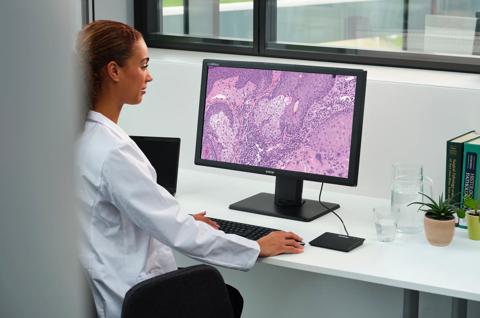
As digital pathology continues to reshape diagnostic workflows, the choice of display system is a critical factor in ensuring diagnostic accuracy and efficiency. In a recent study by IQVIA Laboratories, ADC Therapeutics and Barco, ‘Comparison of digital displays for efficient diagnosis and accuracy’, we compared the performance of three types of displays – medical-grade, professional-grade, and consumer-grade. The results showed that the medical‑grade display performed significantly better. In this article, we’ve summarized its key findings and their implications for clinical practice.

Digital transformation and the importance of the monitor

Digital pathology enables pathologists to interpret whole slide images on digital displays, supporting remote diagnostics and integration with computational tools. However, the reliability of these workflows depends not only on the quality of scanners and software, but also on the display used for image review.

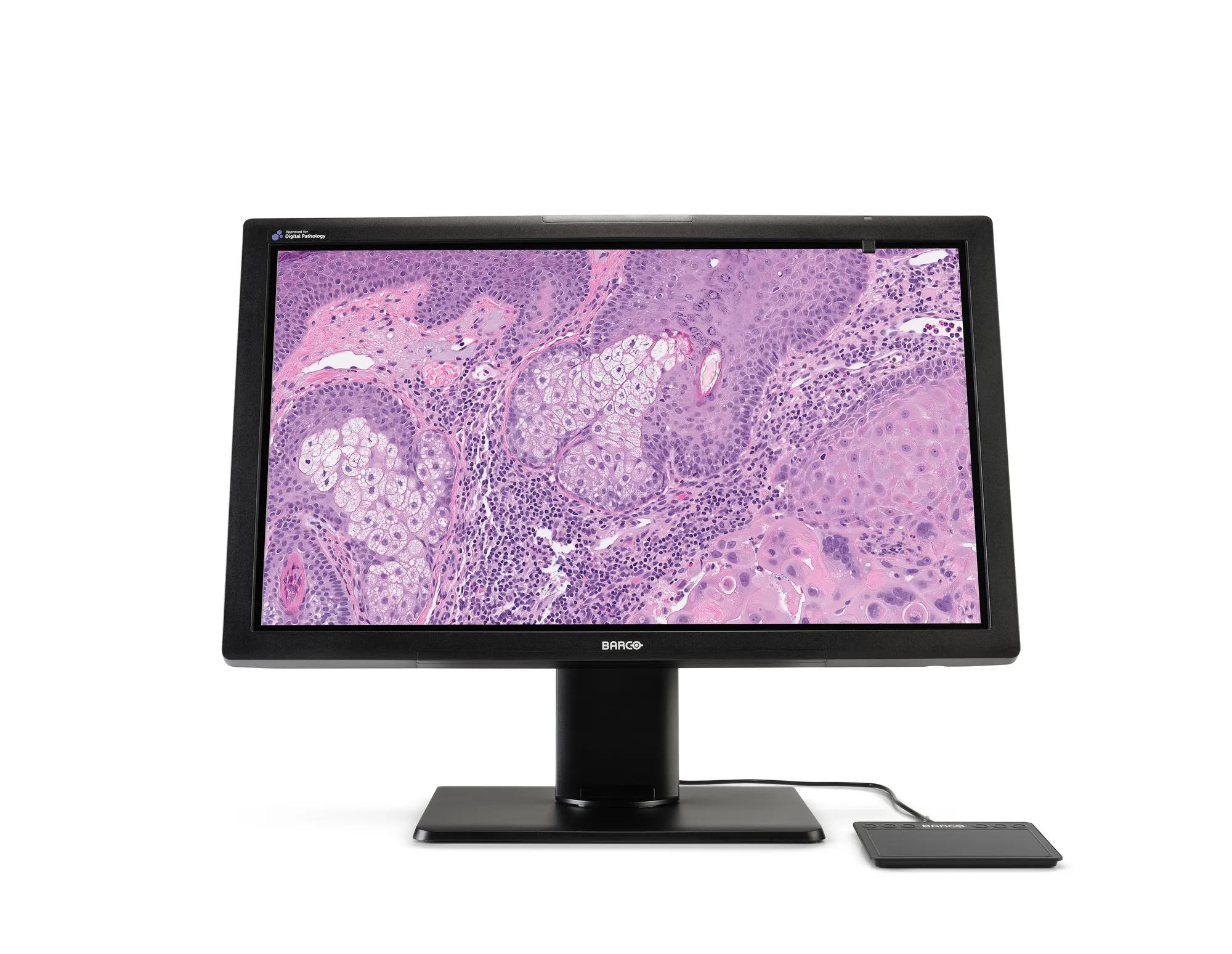
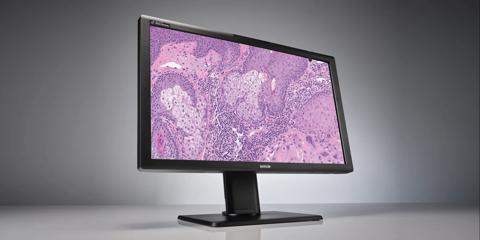
The study evaluated the diagnostic accuracy and user experience of a medical-grade display (our own MDPC-8127), a professional-grade display, and a consumer-grade display, using 19 H&E and 19 immunohistochemistry (IHC) slides assessed by two board-certified pathologists.

Key findings: Medical-grade displays deliver superior results

The results were clear: while all displays performed reasonably well, only the medical-grade display achieved perfect concordance (100%) with conventional microscopy for H&E (the most common stains used) slides while the professional- and consumer-grade displays showed lower concordance (85–95%). 

The medical-grade display also received the most favorable evaluations from the board-certified pathologists, with excellent brightness, and color fidelity. The cellular details and staining characteristics of the medical-grade display were described as crisp and sharp, and no pixelation was observed.

In contrast, the consumer-grade display was perceived as inferior, particularly in color reproduction and the visibility of cellular details.

What makes medical-grade displays different?

Features such as real-time luminance and color calibration and stabilization, high resolution, and a wide color gamut contribute to consistent image quality over time. These attributes are especially important for visualizing subtle histopathological details, which can be critical in challenging or borderline cases. While professional- and consumer-grade displays may offer high initial performance, they often lack the calibration and quality assurance mechanisms required for sustained diagnostic reliability throughout the display lifetime.

Clinical implications: Ensuring reliability and safety

The study concludes:

These findings reinforce the importance of using clinically validated display systems equipped with automated calibration and quality assurance mechanisms to ensure consistent diagnostic performance over time.

As digital pathology becomes more integrated with remote workflows, establishing minimum performance standards for display systems will be essential for patient safety and clinical confidence.

Prioritizing display quality in digital pathology

In summary, while all displays in the study performed well, medical-grade displays like our MDPC-8127 provide clear advantages and achieves higher concordance with conventional microscopy.

Medical-grade displays often include integrated quality assurance mechanisms such as real-time luminance stabilization and automated calibration. International guidelines from organizations such as the European Society of Digital and Integrative Pathology, the Royal College of Pathologists, and the College of American Pathologists underscore the importance of display quality in ensuring diagnostic equivalence with conventional microscopy.

We encourage professionals working in labs to consider display quality as a key component of their digital pathology setup, ensuring that technology supports – rather than limits – clinical excellence.

Reference

Monika Lamba Saini, Amanda Hemmerich, Anna Banach-Ovens, Hannah Manssens, Robbie Dougan, Tom Kimpe, John D. Cochran, 'Comparison of digital displays for efficient diagnosis and accuracy', Journal of Pathology Informatics, Volume 20, 2026.

Tom Kimpe

VP Technology & Innovation

Tom Kimpe holds a Master of Science degree in computer science engineering, a Ph.D. in electrical engineering/medical imaging from Ghent University, and an MBA from the Vlerick Management School in Belgium. He is inventor of several patents, and (co-)author of tens of scientific publications in the domain of medical imaging & displays, visualization, human vision perception, quality assurance and calibration, optics, image processing and artificial intelligence. Dr. Kimpe leads Barco’s healthcare innovation activities, collaborating with universities, research institutes, hospitals, and medical device companies.

Read more

Other articles by this author

Zurück
von ... Weiter