Context
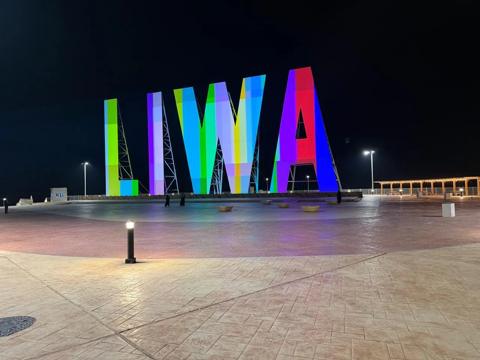
The Liwa Sign stands as a striking cultural beacon in the heart of the Al Dhafra region, a vast desert area that represents nearly 70% of Abu Dhabi’s landmass and is known for iconic events like the Liwa Date Festival and the Liwa International Festival celebrating traditional Emirati heritage.
Officially recognized by Guinness World Records, the landmark is an impressive 23.59 meters tall, built from 49 tonnes of metal, and positioned dramatically atop a hill 197 meters above sea level. This elevated placement makes the sign visible from miles across the desert dunes.
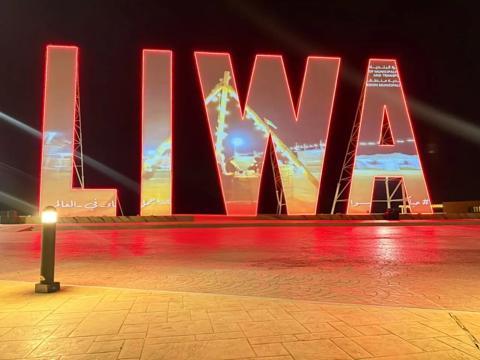
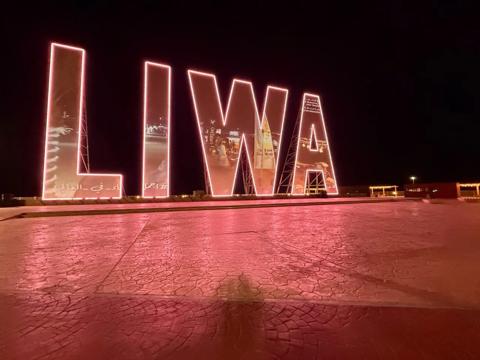
Already a celebrated daytime attraction, the Municipality wanted to enhance the landmark’s visibility and cultural relevance at night by projecting high‑definition stories, imagery, and cultural content onto its massive vertical surface.
To do so, they envisioned a permanent, fully remote, desert‑proof visual mapping system capable of running autonomously, all while delivering spectacular, high‑brightness visuals to travellers and festival visitors.
Challenge
With its sheer vertical scale and symbolic importance, the Liwa Sign offered the perfect canvas for the nighttime cultural experience, but it also posed a series of challenges. The mapping required extraordinary brightness levels to ensure clear, vivid imagery across long projection distances and variable desert lighting conditions. Its position on a hill added further technical complexity, demanding highly precise 3D mapping to compensate for the steep throw angle and the structure’s towering proportions.
Beyond the optical requirements, the harsh environment of the Al Dhafra desert introduced additional obstacles: extreme temperatures, sand-filled winds, and the need for fully autonomous operation in a remote location. The municipality was determined to create not just a functional installation, but a spectacular and reliable nighttime attraction capable of supporting major cultural events.
Solution
To bring the vision to life, the Al Dhafra Region Municipality partnered with Aesthetix as the systems integrator, relying on their engineering expertise to design and deploy a robust, end‑to‑end setup tailored to the site’s unique geographical challenges. They selected Barco as the core projection technology provider, recognizing the company’s unmatched ability to deliver high‑brightness, precision-controlled imagery at monumental scale. Martin Professional Middle East supported the project as the distributor of the Barco projectors.
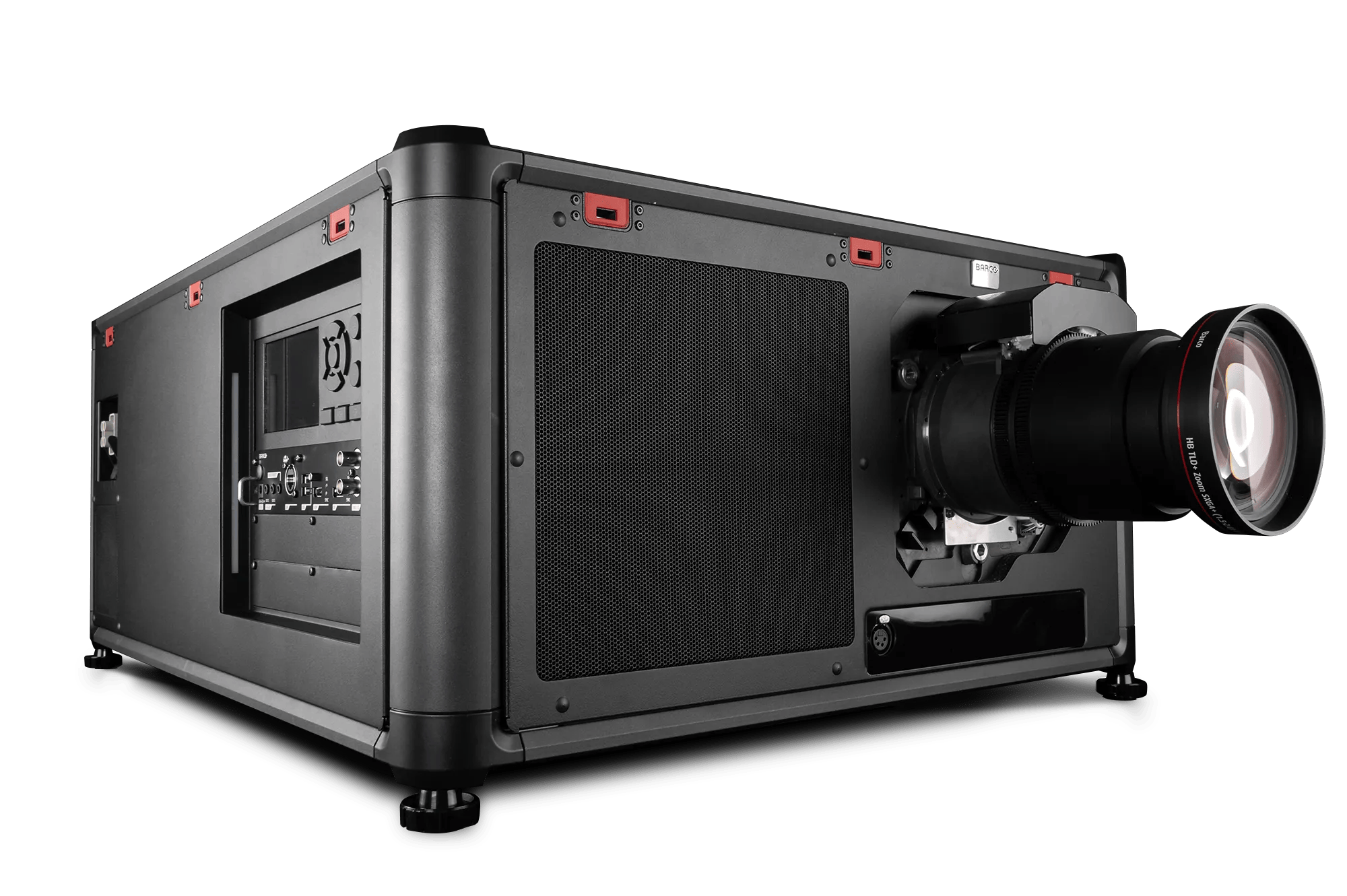
The installation features a fully customized configuration of QDX projectors, including five QDX-W45 units delivering 41,000 lumens and two QDX-W35 units delivering 33,000 lumens. The QDX platform’s optical performance ensured that visuals remained clear, uniform, and color‑accurate.
To achieve the monumental luminance required, the projectors were paired with Barco’s stacking frames in configurations of three projectors operating flawlessly as a single, ultra‑bright source. This precision stacking not only amplified brightness but ensured perfect geometric alignment across the sign’s tall, narrow structure; a critical factor for stable, high‑resolution 3D mapping.
Built for resilience, the QDX series also delivered a strategic advantage in the Al Dhafra environment: their proven durability when paired with specialized enclosures allowed them to run reliably despite heat, sand, and remote operating conditions.
Integrated with Dataton WATCHOUT 7 for advanced content playback, and supported by a fully engineered ecosystem of CCTV monitoring and high‑quality audio, the Barco projectors formed the technical backbone of a brand‑new installation designed entirely around the landmark’s unique shape and location. With this robust ecosystem in place, the installation was completed on 30 November 2025, transforming the hilltop site into a fully autonomous, desert‑proof multimedia landmark.
Results
The completed installation has dramatically reshaped how visitors experience the Liwa Sign, elevating it from a static Guinness World Record landmark into a nighttime icon of innovation and cultural expression. The Department of Municipalities and Transport celebrated the project as a world-first achievement, successfully pairing a record-breaking physical structure with a permanent outdoor projection show. This transformation has significantly enhanced global visibility for the region, positioning Al Dhafra as a destination where engineering ambition meets artistic storytelling.