
Employees move constantly between internal standards and external requirements. A company may standardize on one platform, but customers, regulators, suppliers, and partners often do not.
An article by David Danto, first published by TalkingPointz.
For years, enterprises approached meeting room strategy a little like rooting for a favorite football team. Once an organization picked its side, the room was expected to wear that jersey, run that playbook, and defend that platform at all costs.
That made sense when work was simpler, but today’s meetings do not care which team the room roots for. The next call may be internal, external, regulated, customer-driven, supplier-driven, or on a platform nobody in IT planned for when the room was designed.
One path was to standardize rooms around a single collaboration platform. If the company ran on Microsoft Teams, then rooms became Teams rooms. If another platform dominated, the room followed that ecosystem. The benefits were clear: consistency, simplified support, and familiar workflows. The other path was to make rooms generic BYOD spaces. Users would bring their own laptops, connect to room peripherals, and launch whichever meeting application they needed.
These were the best approaches at the time. Both approaches solved part of the problem, but neither fully solved the way work happens now.
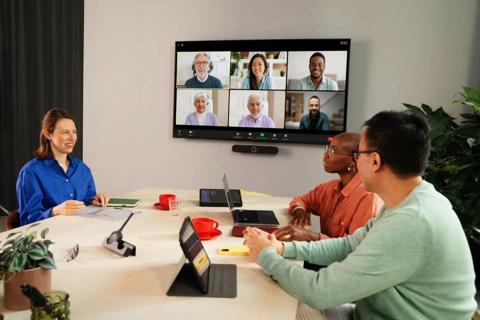
The smartest meeting rooms are no longer single-platform rooms or generic BYOD spaces. They are rooms that deliver a native experience for the platform the company uses most, while preserving open access to other platforms through the user’s native application whenever the next meeting requires it – and doing it simply and without needing IT or third-party intervention.
That distinction matters because interoperability is no longer occasional. It is the daily enterprise reality.
A day in the life of the modern employee
Consider a mid-level manager at a multinational enterprise.
The first meeting is an internal planning review on Microsoft Teams. The second is with an external supplier using Zoom. The third is a partner update on Webex. Later in the day, a regional customer requests a sovereign or industry-specific collaboration platform.
None of this is unusual anymore.
Yet many rooms are still designed as though every meeting happens on the same platform. That creates friction exactly where organizations feel it most: at the start of the meeting.
Why native still matters
Despite the need for flexibility, native room experiences remain highly valuable.
When an organization standardizes on Teams, a well-designed room lets users walk in, press start, and begin immediately. Calendars are visible. Audio and video devices are optimized. Controls are predictable. That speed matters.
It reduces wasted time, lowers support calls, and increases trust in room technology. Employees use rooms that work. IT teams value repeatable deployments. Leadership values meetings that begin on time.
Native room experiences deserve their place in modern workplace strategy.
The problem begins when native becomes exclusive.
Existing interoperability
Option one:
direct guest join
Some platform providers have introduced direct guest join experiences.
If Platform A and Platform B negotiate interoperability, users may be able to join one platform from another room system without leaving the native room console.
That can be useful in specific cases. It may offer a convenient bridge for common meeting scenarios. But these experiences are often limited compared with using the actual native application of the destination platform.
Common compromises can include:
- Reduced video quality or layouts
- Limited content sharing behavior
- Missing advanced controls
- Inconsistent feature parity
- Lower familiarity for users
- A generally non-premium experience
Direct guest join can be helpful, but it is rarely the same as using the destination platform natively.
Option two:
third-party bridging services
Another approach uses third-party interoperability services that connect platforms together.
These solutions can be valuable in larger or more specialized deployments. They may help unify multiple ecosystems or provide scheduled routing between environments.
But they also add another operational layer.
That can introduce additional considerations around:
- Deployment planning
- Licensing and budgeting
- Vendor coordination
- Support ownership
- Ongoing administration
- Additional dependencies
For some enterprises, that is acceptable. For others, it is complexity added to a workflow that should be simple.
Why native on the notebook can be the better experience
A more practical model is increasingly clear: preserve the native room experience for the platform used most often, but when another platform is required, let the user launch that meeting natively on their notebook or BYOD device.
This approach has several advantages.
First, the user is running the real desktop client of the destination platform, not a reduced guest mode.
Second, they retain familiar controls, layouts, chat, plug-ins, and account settings.
Third, they still benefit from the room’s camera, microphones, speakers, and display.
Fourth, they avoid dependence on bilateral vendor agreements or intermediary services.
That often creates the best of both worlds: native room simplicity for internal meetings and native application fidelity for external one
Wireless matters more than many realize
A room designed only for one platform often becomes awkward the moment a different meeting arrives.
Not all BYOD interoperability is equal.
Users search for cables. Someone requests an adapter. Audio routes incorrectly. Participants wait while the room becomes a troubleshooting exercise.
The irony is that these rooms often contain excellent cameras, microphones, displays, and speakers. The hardware is capable.
The experience breaks down because the room assumes every meeting follows the same rules. That assumption no longer holds.
External meetings are not exceptions. They are normal work.
If these external meetings still require cables, adapters, or table hubs, many of the old problems remain. The meeting may technically work, but the experience still suffers. Does the right connector exist in the room? Are the wires where they are supposed to be? Do they reach to where they need to?
Wireless BYOD changes the equation.
Users can enter the room, connect quickly, and use their own native application without searching for hardware.
- Faster starts
- Fewer support tickets
- Cleaner tables
- Higher user confidence
- Better room utilization
- Less guest frustration
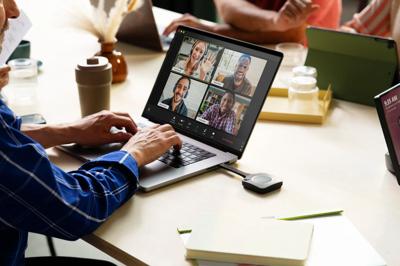
The difference between "possible" and "successful" interoperability is often ease of activation.
Modern wireless is not yesterday's wireless
It is also important to distinguish current-generation wireless room solutions from older assumptions.
Years ago, some enterprises locked down USB ports for security reasons. In those environments, early wireless room systems could become unreliable or fail entirely because they depended on legacy USB behavior. In those cases, the wireless USB connection might not work unless a package of software was preloaded onto all notebook images.
Many IT leaders still remember those difficult experiences.
But modern enterprise-grade solutions have evolved significantly.
Current designs can detect locked-down USB environments and shift to alternative connection methods that emulate a display-class interface rather than depending solely on traditional USB access. In practice, that means the system can continue to function predictably even in tightly managed enterprise environments.
This is more than a technical footnote. It means organizations evaluating wireless room solutions today should assess current capabilities, not outdated perceptions formed from first-generation products.
The category has matured.
Future-proofing for what comes next
Interoperability is not only about today's major platforms.
Around the world, sovereign collaboration platforms, industry-specific tools, and regional alternatives are becoming more relevant. Enterprises may also encounter new platforms through mergers, partnerships, or customer mandates.
No organization can perfectly predict what it will need three years from now.
That makes openness strategically valuable.
A room that supports native primary workflows plus flexible wireless BYOD access is better positioned for future change than a room locked to one ecosystem.
Interoperability is no longer just convenience. It is resilience.
A strong example of the model
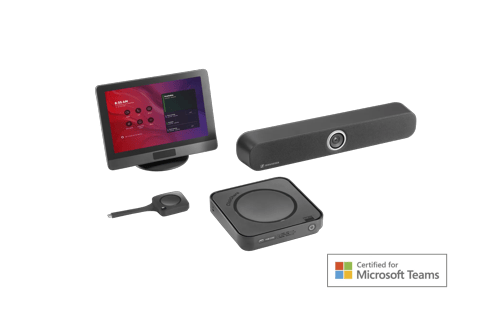
Several vendors are pursuing this direction. One notable example is Barco's ClickShare approach, which emphasizes wireless room access and BYOD simplicity while fitting into Microsoft-centric environments.
That matters not because one vendor defines the market, but because it reflects where buyer demand is moving.
Organizations increasingly want solutions that do not force a tradeoff between standardization and openness.
The room that matches modern work
The smartest meeting rooms are built for reality, not ideology.
They recognize that standardization and flexibility are not opposites. They preserve premium native experiences where they matter most. They provide open access when outside platforms are required. They remove friction in the first two minutes of the meeting, where user confidence is won or lost.
The result is a room where internal meetings start instantly, external meetings happen smoothly, and future meetings remain possible.
This is no longer optional.
It is what modern work requires.