
The agent is no longer a tool the meeting uses. It is a member of the team.
We have reached Peak Meeting. Look at how company knowledge is scattered: some in email, some in chat, some in files of multiple formats, some in a CRM, some only in the heads of three people who met near the coffee machine last Tuesday.
So we schedule meetings to unify the fragments: status updates, standups, all-hands. These meetings are not where work happens. They are where we attempt to create a complete picture of the state of the project or the company. The answer is to stop reconstructing that picture piecemeal. Imagine a structured, continuously updated model of the work, maintained by software agents rather than assembled in a conference room, a shared representation of the state of the organization.
Those agents don't just maintain the model from the outside. They sit in the room, reading and reasoning over the same situation as the people present, and acting on it. The agent is no longer a tool the meeting uses. It is a member of the team, a peer contributing to the same call.
Why AI agents need to understand the room
For thirty years the industry has built tools to make meetings better for remote participants: sharper cameras, cleaner audio, and smarter framing. But those serve human eyes and ears. An agent comes without senses, and a transcript doesn't give it the information and context to follow what is going on. For agents to be real participants, they have to understand the room. Real understanding has three layers: the geometry of the room, the people in it (who they are, where they are, where their attention goes), and the interactions among them (who addresses whom, who leads, how turns are taken).
The three layers of real understanding
Room layout, positions, distance, orientation, and shared spatial context.
Who is present, where each person is, and where attention goes.
Who addresses whom, who leads, and how turns are taken.
Room intelligence starts at the edge
This is the work Huddly was built for. We do not just transmit the room, we perceive it, and we structure that perception so agents can use it. That understanding has to be built in the room, not the cloud: pushing multiple high-resolution video streams to a cloud LLM moves too much data to get anything back. So the processing happens locally. That is why our devices are AI nodes: the C1 AI-driven video bar, the C1 Crew with integrated audio, the Crew five-camera system, every product in the portfolio. Each one runs specialized edge AI models, fusing the signals of multiple devices into one representation before anything leaves the room. That fusion is what builds fidelity: a read of the room faithful enough to act on. Our devices resolve the three layers (geometry, people, interactions) into knowledge an agent can use.
And the same perception does not switch off when the meeting ends. It runs ambient: the room understands its own occupancy and use, around the clock, feeding facilities and operations. A capability that serves one workflow is a feature. One that serves many is infrastructure.
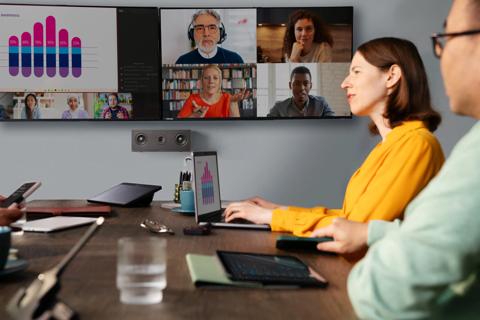
Bringing structured room perception into Microsoft Teams experiences
Until now, that understanding stayed locked inside our own software. A device handed the meeting platform video and audio over USB, and everything it knew about the room stopped at that connection. Huddly Director was the only thing that could consume and act on it. Then Teams opened an AI data channel, and the understanding became available to any agent on the platform. Huddly C1 can now share its structured perception of the room, not just pixels.
Take the most immediate benefit: attribution. The structured perception C1 shares is what powers IntelliFrame people labels in Teams, so the platform can put the right name to the right person, and the agent can attribute each decision and note correctly. That is structured perception doing what a transcript alone never could, and it is only the first of many things this channel of understanding makes possible. Further out, an agent that can read the room knows when to ask the question that closes an institutional knowledge gap and when to supply the context that keeps a conversation moving, because structured perception is what gives an agent social skills.
Where Huddly perception meets Barco experience
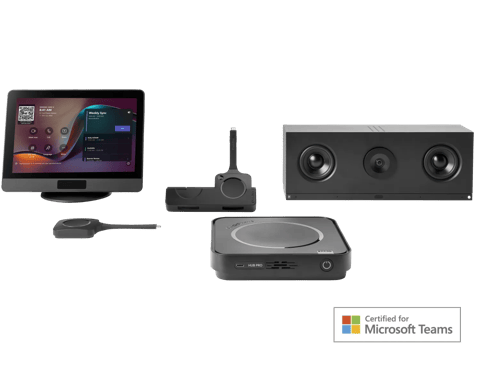
The structured perception our devices produce must be received and acted on by the compute at the heart of the room, and that compute is Barco: the ClickShare Hub and Hub Pro, the Teams devices through which our understanding becomes user experience. The room is perceived once, and that single understanding then drives multiple workflows: the meeting, then facilities, occupancy, whatever comes next.
The meetings that remain will matter more
Once the state of the work lives in one shared place, not every meeting survives. The ones that exist only to move information from one system to another (status, readouts, manual integration) don't, because the shared model already moves that information, with no meeting required. The decision-making meetings get shorter and sharper. The irreducibly human meetings (building trust, working through conflict, persuading, showing you care) grow more important, not less. The hour you spend in a room becomes denser and more valuable, because it is spent doing the work, not talking about it.

Routine updates move through the shared model, not another meeting.

Teams meet to decide, align, and move forward faster.

Trust, conflict, persuasion, and care become the reason to meet.
Building infrastructure for the agentic era
A meeting worth keeping is worth equipping for. Budget hardware cannot resolve a room at this fidelity, and signal from a single camera at the front cannot be enhanced after the fact. As an industry, we must stop treating the camera as a peripheral that produces audio and video streams and start treating the room as infrastructure that produces understanding. The firms native to the AI world will be the ones whose rooms can perceive, and whose agents can act on that perception.
With Barco, we build that room today. Huddly builds the perception. Barco builds the experience it flows into. Neither half is enough on its own: perception with nowhere to land is wasted, and experience with nothing to perceive is blind. It scales from the huddle room to the boardroom, and both companies build to the standard the most sensitive spaces require: TAA-compliant, ready for regulated and government rooms. Together we deliver the room the agentic era needs.
Ready to build AI-ready meeting rooms?
Discover how the ClickShare Hub Pro + Huddly® C1™ room system brings Microsoft Teams Rooms, intelligent room experiences, and effortless wireless conferencing together in one modular solution.