
Barco search

myBarco notifications

Unread

Read

You don't have any notifications.

The difference between LED and laser projectors

Future review · 3 min read

Lamps, LEDs and Lasers are the three most common light sources for projectors, with the latter two quickly gaining market share. Lamp based projectors are still commonly used today in home theaters, that generally operate only a few hours a week. However, their limited lifetime is not very appealing to professional customers. Especially when used intensely, LED and laser replace lamps as both the most desired and most economic option. In this article, we therefore only focus on LED and laser.

Over the past few months, we have been talking a lot about the advantages of laser projection vs. LED – its higher brightness, longer lifetime, lower power consumption, and lower total cost of ownership (TCO). We have shown the graphs and statistics to prove all these benefits.

But today, I want to tell you WHY laser illumination is so much more awesome than LED. Now don’t expect me to dive into quantum mechanics, because the details are complicated and not really my domain. But I can tell you the basic principles, which is all you need to know to understand any conversation on the subject. It’s a bit like learning history by watching cartoons: you won’t become a professor, but you will understand the essential themes and concepts.

The perfect coherence of laser light

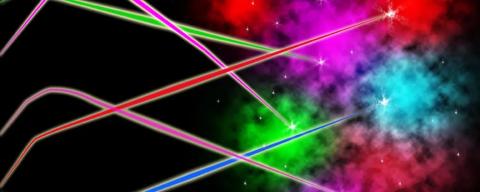
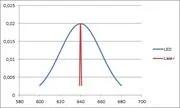
One of the biggest differences between laser illumination and LED is the brightness produced by the projection system. For the same power input, laser light engines beat LED engines any day. The reason is focus and teamwork. A laser produces a really focused light beam. If you point it at something, it produces a dot. For LED lights, this is very different: the light is much more scattered and creates a large circle.

The same concept applies to light. Laser light is by definition coherent. This means that all light photons are in exact pace and moving in exactly the same direction. LED light (and all natural light by the way) is not coherent, so the photons do not all move in the same direction. The energy of the beam is therefore much less focused, and more energy is lost.

New evolutions

Laser light sources have at the moment the advantage of high brightness. If this will remain the case is however somewhat questionable. Significant investments have been made in LED light sources, and the newer generations are catching up with lasers.

They probably will never reach the very high levels needed for example for projection mapping on buildings, but for other applications LED projectors definitely have a future beyond home entertainment.

Did you like this post? Then please share!

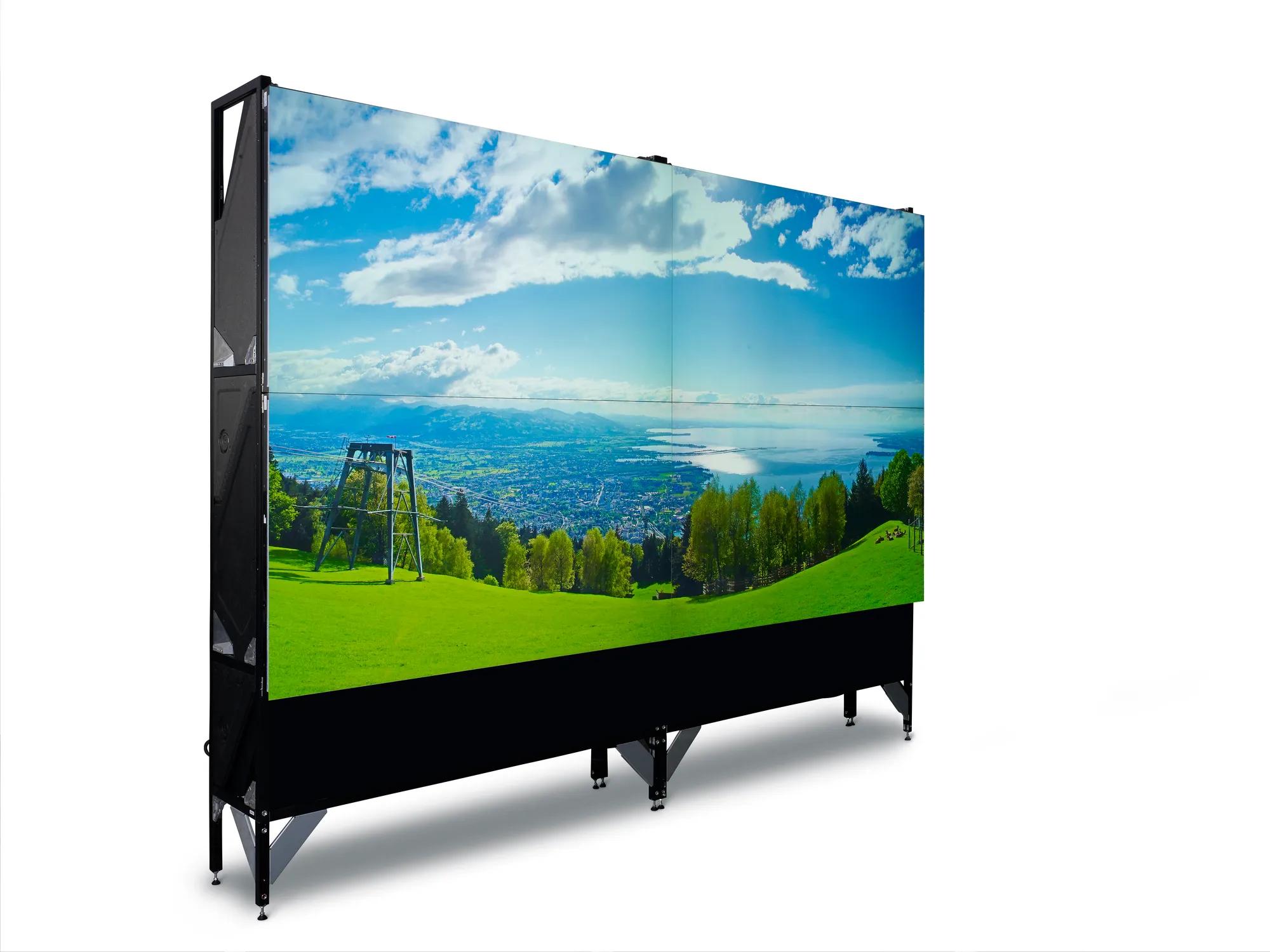
Visit the RGB laser video wall page to know more about the benefits of RGB laser rear-projection.

Other articles by this author

Related articles

news · 6 min read · Future review · Jan 13, 2017

Top 5 questions to ask when selecting a video wall

Millions of square feet of video walls are being installed annually − and the market is enjoying double-digit growth. There are more options than ever when it comes to building large video walls for 24/7 control rooms. While some video walls must “wow” prospective viewers visually to catch their attention (i.e., advertising ala digital signage), others focus on ergonomic design, functionality, serviceability, and critical data within a continually manned 24/7 decision-making environment (i.e., control room).
beautiful colored smoke on white
news · 4 min read · Displays · Future review · Jun 20, 2019

What is a display’s white point and why should you care about it?

The white point in color definitions is probably one of the least known parameters on a display’s spec sheet. Because what does it even mean? White is white, no? Most people know it is the combination of all wavelengths of light. So how come different settings exist in the market? The reason is that the theoretic value of white is never seen in reality. If you look at a white piece of paper for example, it will be colored by the light source that shines on it. In other words it will look different when you look at it under sunlight conditions, than under artificial light in your office. The same goes for displays. However, the cool thing is that we can often choose the white point of the display. Tampering with the white point setting will consequently impact and define the mood of the image. Note that for convenience we will be talking about displays in this article, but the same goes for just about any visualization device, including projectors and direct view LED tiles.
news · 6 min read · Video walls · Mar 10, 2021

Which video wall technology best suits your television studio?

Some people look good on TV, others don’t. And the same goes for video walls. That is why television studios have some very specific requirements for their backdrops. So which of the three dominant technologies – direct view LED, LCD and rear-projection cubes (RPCs) – best answer these requirements? In this article, a follow-up to the one on control rooms and corporate lobbies, we highlight the most important parameters.