
Article · 2 min read · Apr 27, 2026
4 min read

On election night, a single result travels a long way before it ever reaches a screen. It starts at a polling location, moves through a network, gets aggregated with dozens of others, and finally lands on the shared display in an election operations center. Every step in between is a place where something can go wrong. Barco CTRL is a solution that was designed exactly around reliability and security, making sure critical operations run as smoothly as they should. That is the challenge Barco CTRL, the KVM over IT solution for control rooms, was designed for: reliable and secure operations at every step.
Most conversations about election security focus on the two ends of that journey: the voting machines that produce the results, and the public reporting that shares them with the media and the public. The middle stretch, the operational center that collects, routes, and displays everything in between, tends to get far less attention. That is a gap worth closing, because that middle stretch is exactly where an election operations center lives, and it carries real responsibility.
Picture the full path a result takes on election night. A polling location transmits data to a central hub. That hub receives feeds from dozens of similar locations at once. The operations center pulls all of that together, gives coordinators a single workspace to review it, and pushes the aggregated picture to a video wall for the whole room to see. From there, results and insights are shared onward with media partners and other stakeholders.
Every handoff in that chain is a potential point of failure. A network link that is not encrypted. A device that accepts an unauthorized connection. A workstation that anyone in the room can access without being identified. Traditional KVM (keyboard, video, mouse) technology, the hardware that lets an operator control multiple computers from one console, was built to solve a convenience problem: fewer keyboards, fewer monitors, easier switching. It was never designed to secure the handoffs between systems, because at the time it was built, those handoffs were not yet a security concern.

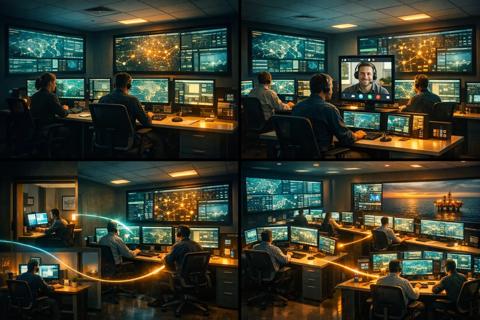
Note: AI-generated image for illustration purposes.
Barco CTRL, the KVM over IT solution for control rooms, treats that entire chain as a single security problem rather than a collection of separate ones. Instead of connecting systems side by side and trusting the space in between, it integrates the full path, from the encoder that captures a source, through the network, to the decoder that renders it, into one platform built on zero-trust principles.

Looks like you haven't accepted cookies
Activate performance cookies to watch this video.
The encoders and decoders that make up a Barco CTRL deployment are locked-down appliances that only run Barco-signed software. There are no open boot settings, no ability to install unauthorized applications, and no general-purpose computer sitting between the source and the operator that an insider or intruder could exploit. Communication between every device is encrypted using TLS 1.2, TLS 1.3, and mTLS, so a result in transit between a polling location and the operations center cannot be intercepted or altered without detection.
The zero-trust part of that architecture means no device, user, or connection is trusted by default, no matter where it sits in the chain. Every access request is authenticated and authorized before it is allowed through, and every one of those interactions, logins, configuration changes, connections, is logged automatically. That creates a continuous, tamper-evident audit trail covering the entire chain, not just the endpoints. For election officials, that record is not an afterthought bolted on for compliance. It runs in the background from the moment the system powers on, and it is available afterward for the post-election reviews and oversight processes that election infrastructure increasingly requires.
For the people actually working the night, the security underneath is invisible. Operators see camera feeds, results data, and dashboards from dozens of separate, intentionally isolated networks brought together on a single canvas, controlled with one keyboard and one mouse. The system is so user-friendly that even volunteers can easily step in to help – with the The underlying networks stay completely separate, as they should for security reasons, but the experience for the person at the desk is one seamless workspace instead of a room full of disconnected screens.

That combination, a fully secured chain from source to display plus a single unified view for operators, is what separates a modern election operations center from a room full of switches and monitors bolted together. Every link matters, and none of them should be the weak one.
Since election infrastructure was designated a critical infrastructure subsector by the Department of Homeland Security in 2017, the expectation for that kind of end-to-end protection has only grown. An operations center is a piece of critical infrastructure in its own right, and it deserves to be secured like one.
Want to see how Barco CTRL secures the full chain, from polling place to results screen? Request a demo at barco.com/ctrl-demo.